
Waste Disposal Website
Web Design Case Study
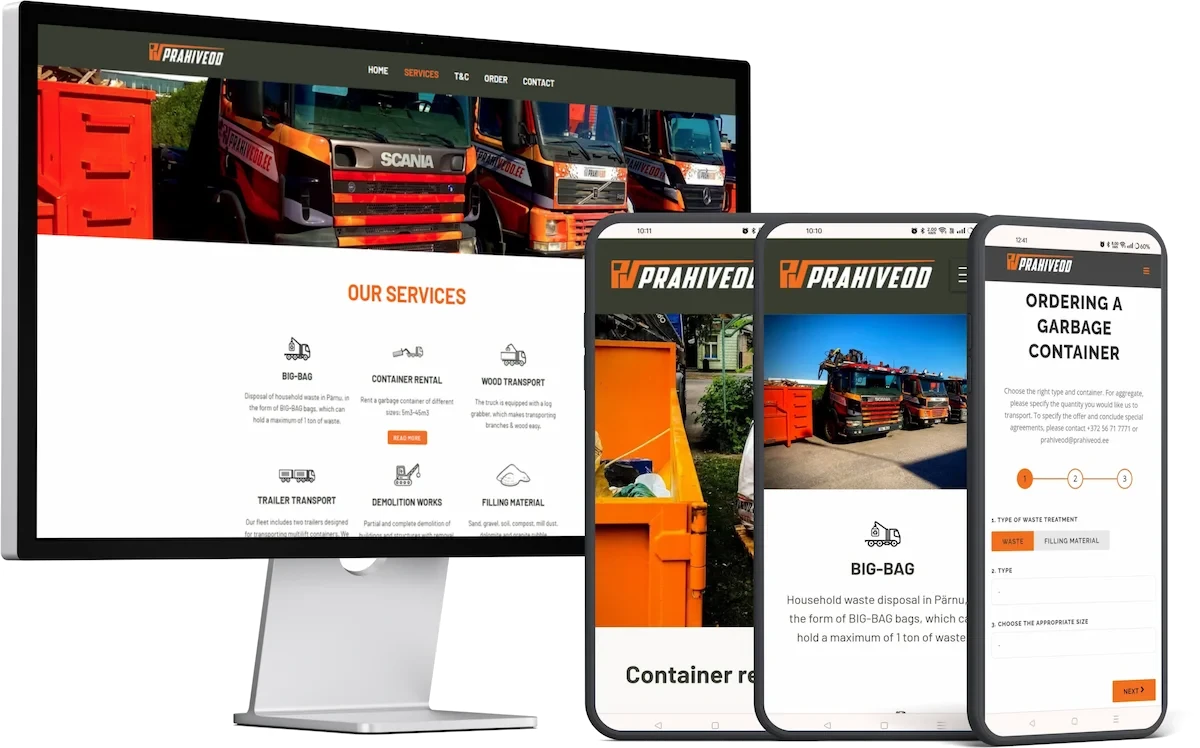
Overview
- 2 formats
- Desktop and mobile experiences
- 1 flow
- Guided waste collection request
- 6 services
- Scannable service categories
- Responsive
- Designed across key breakpoints
Waste collection involves details that can quickly overwhelm a customer: material type, volume, location, timing, and access requirements. This project organizes those decisions into a straightforward website and guided request flow. Clear language and strong hierarchy help customers understand the service while enabling the business to receive more complete order information.
Goals and audience
Primary goal
Help customers identify the right service and submit a useful request without calling for basic clarification.
- Explain the available services in plain, practical language.
- Support customers ordering from a work site as well as a desktop.
- Collect relevant details without presenting one long generic form.
- Build trust through clear contact, terms, and next-step information.
Content and structure
- 01
Understand the service
Introduce the company, coverage area, and most common waste collection options.
- 02
Compare options
Give each service a concise purpose, capacity, and suitability explanation.
- 03
Start an order
Move from the selected service into a request flow with relevant fields.
- 04
Confirm next steps
Set expectations for pricing, contact, timing, and order confirmation.
Visual system
The visual direction combines strong imagery and brand orange with a neutral content system. Repeated spacing, type, button, and form patterns make the site feel consistent across service pages.
- A restrained palette with orange reserved for actions and emphasis.
- Reusable headings, service cards, controls, and feedback states.
- Readable typography and sufficient contrast over imagery.
- Consistent responsive behavior rather than separate mobile layouts.
Custom order flow
- 01
Waste type
Choose the material category so later questions remain relevant.
- 02
Service and size
Select the collection method and appropriate container or quantity.
- 03
Location and timing
Provide delivery, access, collection, and preferred schedule details.
- 04
Review and submit
Check all selections and contact information before sending the request.
Responsive quality
- Touch-friendly controls and clear form labels.
- Keyboard focus, validation, and error feedback.
- Optimized responsive images and stable page layout.
- Semantic headings, meaningful links, and accessible navigation.
- SEO metadata and content structured around customer search intent.
Outcome and handoff
The outcome is a clearer service experience and a structured route from discovery to a detailed request. When final data is available, this section should report outcomes such as completed requests, reduced clarification calls, search visibility, or task success. A strong handoff also explains reusable components, content ownership, analytics events, and how future service pages can be added without redesigning the system.
Reflection
- Explain which content decision had the largest effect on usability.
- Document compromises caused by time, content, or technical constraints.
- List the next accessibility, performance, or conversion improvement.