
Multistep Order Form
Product Development Case Study
Overview
- MVP
- Focused first release
- 3 steps
- Progressive order journey
- Web app
- Responsive product interface
- 1 goal
- Complete a valid order
Long order forms make it difficult to understand what information is needed and how much work remains. This product concept breaks the process into focused steps with a clear sense of progress. The MVP prioritizes the core purchase journey and creates a foundation that can be validated before investing in broader account, administration, and automation features.
Problem and opportunity
A single large form exposes every field at once, mixes unrelated decisions, and often reports errors only after submission. This increases cognitive load and makes abandonment or incomplete data more likely.
Product opportunity
Create a flow that feels shorter to customers while improving the completeness and usability of submitted order data.
Goals and success criteria
- Customers understand their current step and what remains.
- Each step asks only questions relevant to the current decision.
- Validation happens close to the field and never discards completed work.
- The review step clearly summarizes choices before submission.
- The business receives data in a structure that can support later automation.
MVP scope
- 01
Must have
Order type, customer details, location, contextual validation, review, and confirmation.
- 02
Should have
Saved progress during the session, clear error recovery, and responsive behavior.
- 03
Later
Accounts, saved addresses, order history, administration, notifications, and integrations.
- 04
Non-goals
Features that do not help validate the core order journey in the first release.
Core product flow
- 01
Configure order
Select the order type and provide details that determine later questions.
- 02
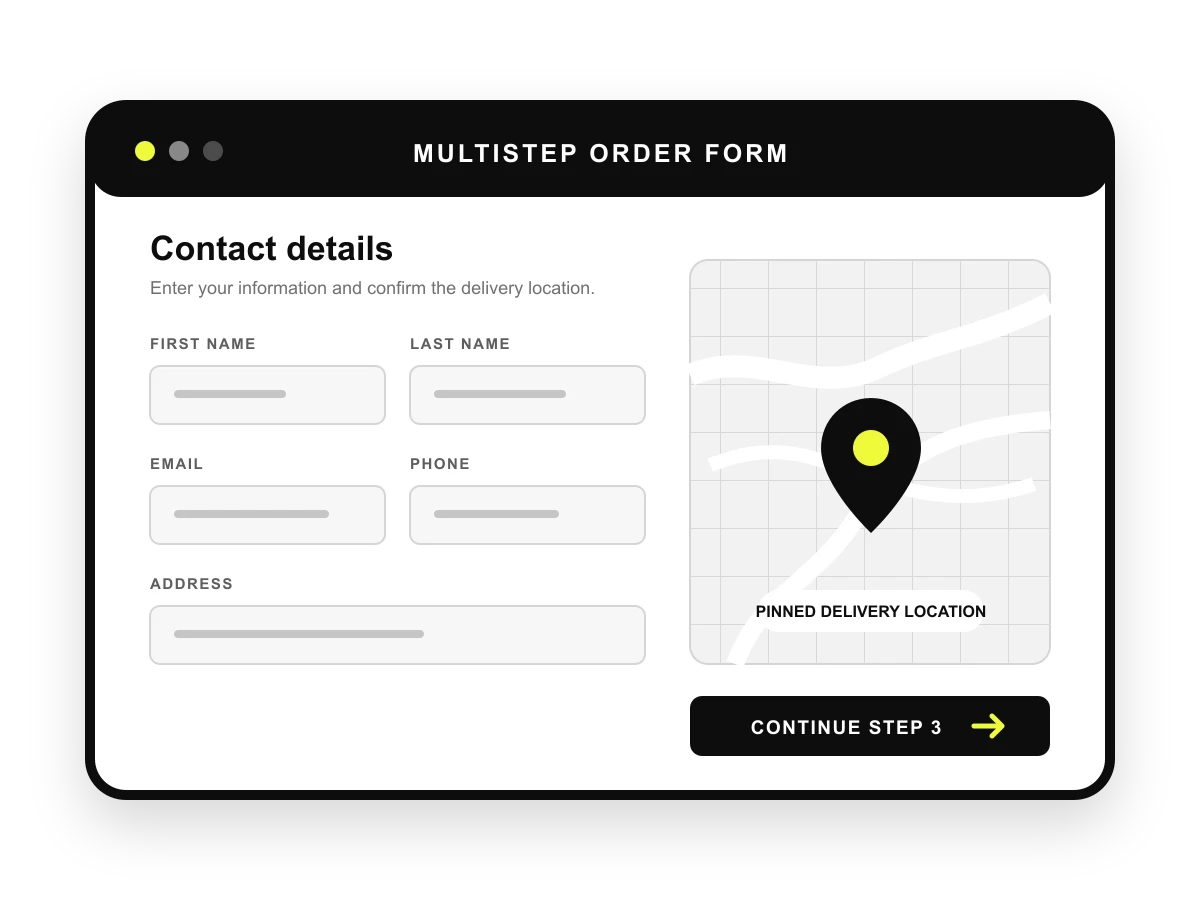
Contact and location
Enter standard contact fields and confirm the service location on a map.
- 03
Review and submit
Verify all selections, correct errors in context, and submit a complete order.
Product decisions
Key trade-off
More steps can feel longer, but focused steps improve comprehension when each one has a clear purpose.
- Use progressive disclosure to reduce visible complexity.
- Preserve entered values when moving backward or correcting an error.
- Show progress with meaningful step names rather than percentage alone.
- Keep a single primary action and make backward navigation predictable.
- Treat location confirmation as a visual check, not only a text field.
States and safeguards
- Empty, loading, incomplete, valid, invalid, submitting, success, and failure states.
- Accessible labels, descriptions, keyboard order, focus movement, and error summaries.
- Server-side validation matching client-side constraints.
- Protection against duplicate submissions and accidental data loss.
- Clear handling for unavailable locations, network failures, and expired sessions.
Technical delivery
This section should document the chosen framework, form-state strategy, validation model, API contract, data persistence, map integration, analytics events, and deployment approach. Include only technical details that explain a meaningful decision, constraint, risk, or user-facing outcome rather than listing tools without context.
Validation and roadmap
Useful evidence could include completion rate, errors per step, abandonment by step, time to complete, support requests, and the percentage of submissions requiring manual clarification.
- Report validated outcomes separately from expected benefits.
- Show what changed after usability tests or production feedback.
- Prioritize roadmap items by observed need, business value, and delivery effort.
- Close with the largest remaining risk and the next experiment.